This is becoming something of a Jordanian “Bucket List” year, not because I don’t think I’ll be back here, but because there are so many things I didn’t get around to the other times I lived here, and I don’t want to miss any opportunities this time. None moreso than this one.
Over twenty years ago, when I was first here as a Peace Corps Volunteer, a married couple among my colleagues were assigned to the village of Umm Al Guttayn along the Syrian border east of Mafraq. They told an infamous story of the last Volunteer, who nearly caused an international incident by accidentally walking into Syria near the edge of town. They also told us about the remarkable remains of an ancient basalt village in their town, and down the road a bit, an even bigger basalt town called Umm Al Jamaal. I was intrigued.
In my very last week of Peace Corps, my parents came to see Jordan with me as their 25th wedding gift to each other, the day before US forces in neighboring Iraq killed the notorious Jordanian-born Al Qaeda leader Abu Mus’ab al-Zarqawi. I had arranged for a driver, the uncle of my village friend and teacher, to take my parents and me to Umm Al Jimaal and the desert castles, but when we had arrived at my friend’s house, she declared it was too dangerous to go into Mafrag and Zarqa where the tribe of Zarqawi predominates. We went to Umm Qais, Pella and Ajlun Castle instead.
When I arrived back in Jordan this year, at my Fulbright intake interview, I found out that one of our soon-departing fellows was a leading archaeological expert on the site at Umm Al Jimaal. My favorite visit to Petra had been in the company of an archaeologist who had worked for decades on Petra’s Great Temple, so I knew I wanted to take advantage of another opportunity like that.
Ancient History

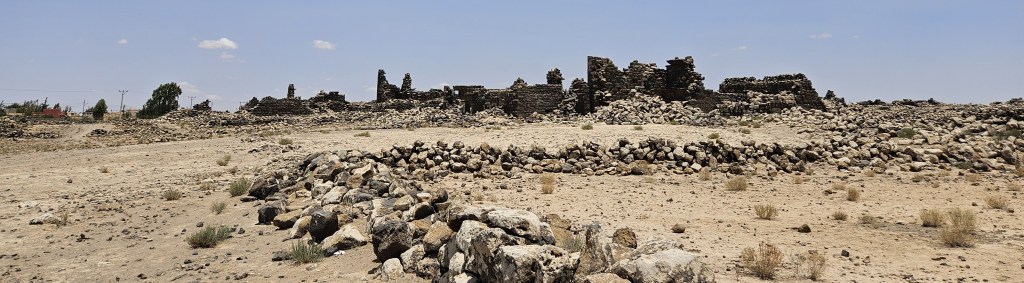
Like Azraq, Umm Al Jimaal sits in the Jabal Al Druze volcanic field of the Harrat Al Shaam or Black Desert, a basalt field stretching from southern Syria, across the northeastern arm of Jordan and into Saudi Arabia. From Umm Qais to Azraq Castle and beyond, this basalt is a popular building material across the region, and of all of the remaining ruins, Umm Al Jimaal is the largest – in fact, one of the largest Greco-Roman or Byzantine settlements still around to study.
It’s known that there was a settlement here at least since the Nabateans made Bosra to the northeast their new capital, of which Umm Al Jimaal was a suburb where some of Bosra’s luminaries made their homes. Archaeologists have not found any evidence of Nabatean builds in their investigation of Umm Al Jimaal. When the Romans under Emperor Trajan took control of the area and made Bosra the capital of Arabia Petraea in 106 AD, they established a garrison in Umm Al Jimaal. While some stones with Roman inscriptions have been reused in other buildings, not much of the original Roman fort still exists.
While the rulers of this town shifted over time — Nabateans, Romans, Byzantines, Islamic caliphates, the Ottomans — the people who lived here were the same people. Inscriptions show that they spoke Nabatean, learned Latin and Greek, and later came to speak Arabic. Throughout it all, however, they were largely the same pastoral, tribal crofters and crafters, going about their daily lives, paying taxes to whomever declared themselves entitled to them.
The height of the importance of Umm Al Jimaal was during the Byzantine Empire, also known as the Eastern Roman Empire, the Christian empire that emerged in the fifth century. The site has a number of churches, a ceremonial gate, some administrative buildings…. But the real value in the site is in being one of the only sites, other than Pompeii, where ordinary residential buildings remain.

Residential Byzantine
To be honest, Umm Al Jimaal looks a lot like a field of piles of rocks, but it has some of the best signage I’ve seen in Jordan, and with the help of our archaeologist guide, structures and details begin to emerge.

As you wend your way between the piles of basalt on pathways, partly cleared by archaeological teams and partly paths of convenience for locals crossing from the halves of the village on either side, partial walls, especially corners, are still standing up from the rubble. The houses would have been plastered over, inside and out, so most of the basalt is quite rough-cut, but around corners, doorframes and windows, the stones are quite precisely cut with right angles. Along the jagged collapsed ends of the walls, you can also peek into the construction techniques, how walls have inner and outer skins with rubble and clay poured in between.
When you start counting windows, you begin to see that most of these homes were two stories, often three, sometimes even four. You can also see that the ground level was once much lower, with windows half-buried in the dirt that might once have been at eye level.
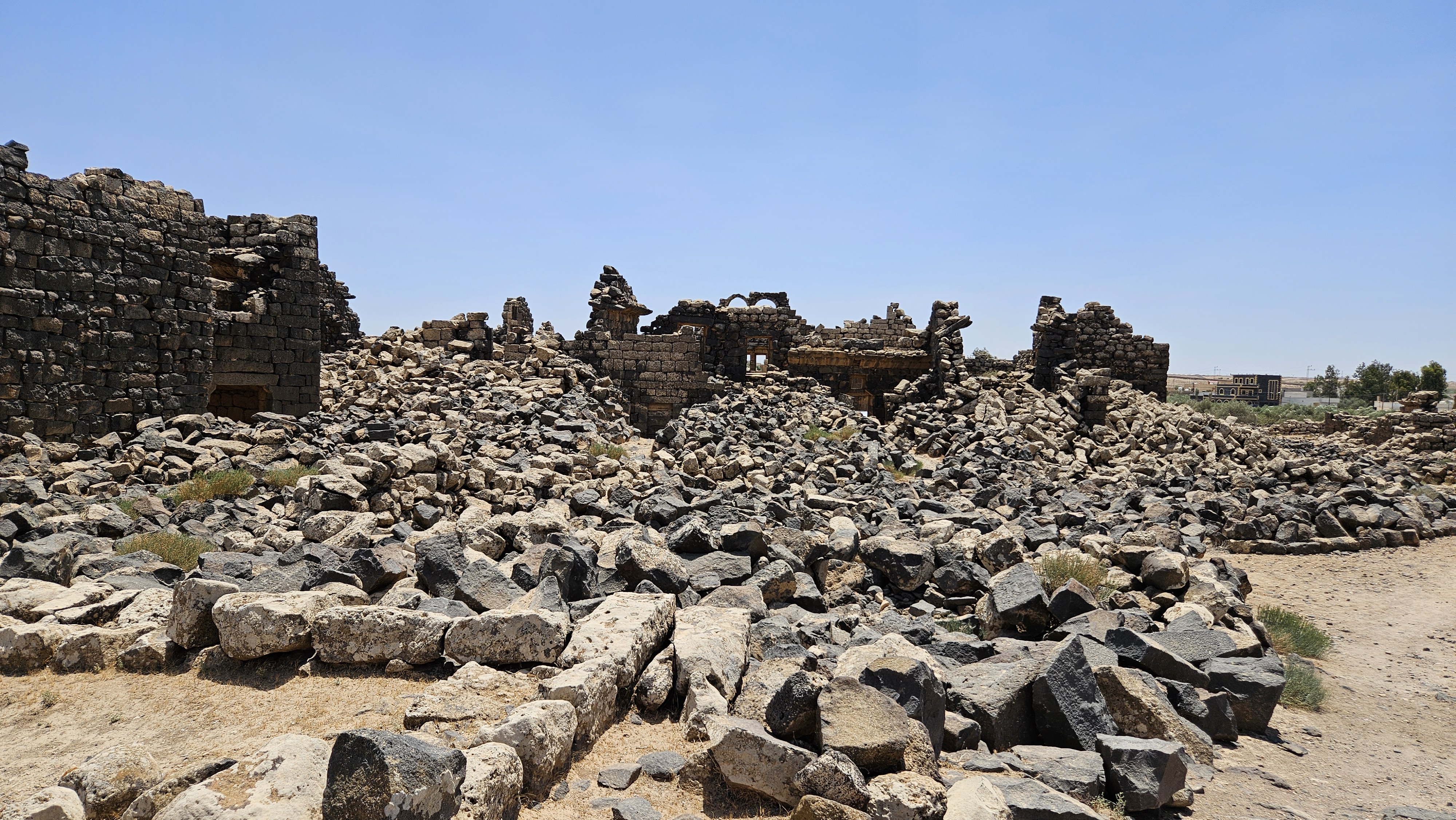
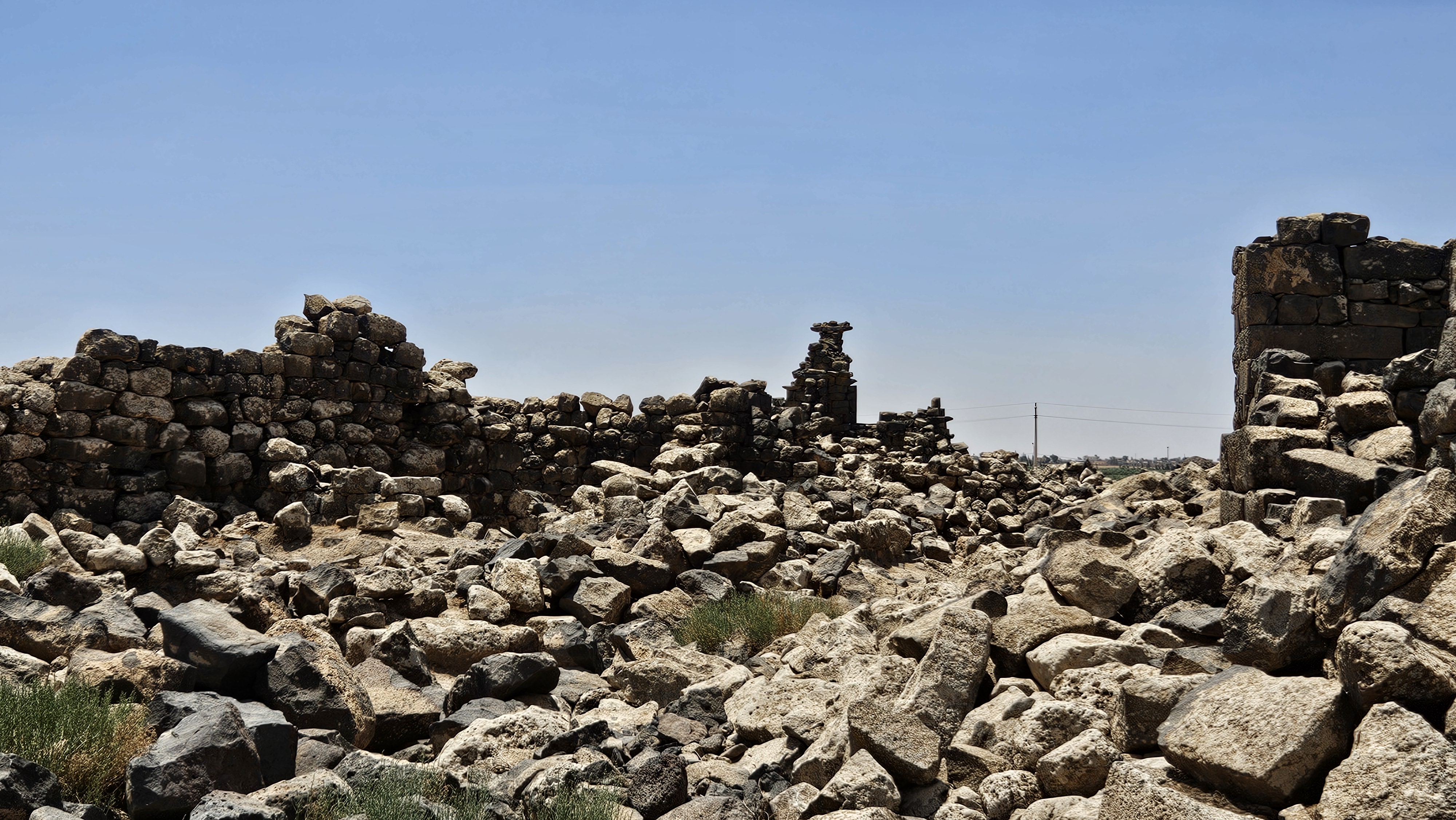


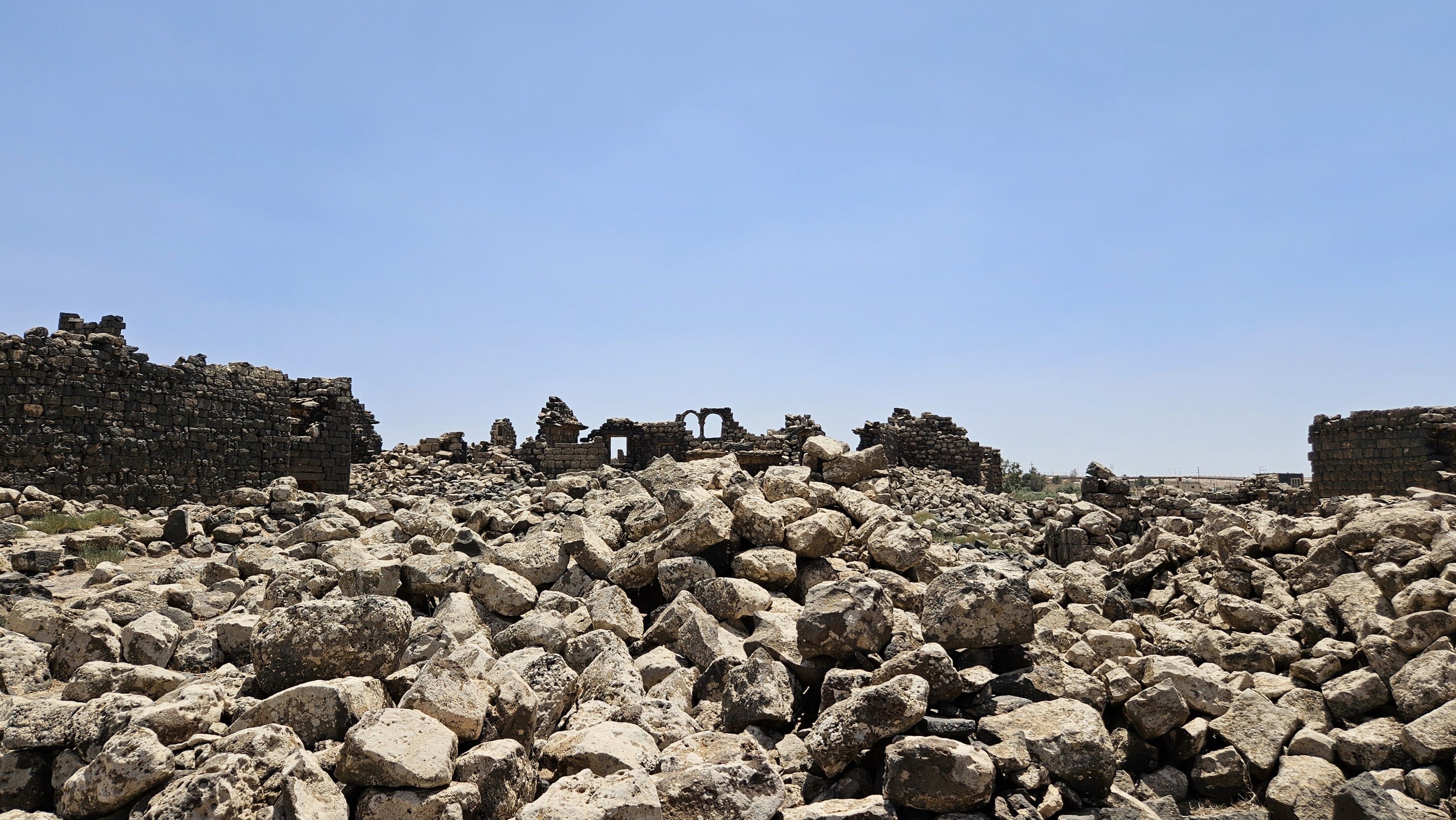


The Byzantine builders of these homes used all the combined architectural knowledge of the Greeks, Romans and indigenous traditions. In some structures, the mortarless basalt arches may be among the only remnants of the building still standing. In doorways, you can see the grooves in the thresholds where the hinges of basalt doors would be slid into place. A few other techniques stand out, and we learned a lot today about corbelling.
Corbelling
This is the technique used to construct ceilings and rooves in most of the buildings here in Umm Al Jimaal. If you want to geek out as much as (or more than) I did about this, check out the page-turner Ancient masonry structures within an integrated approach: the reinforced corbelled flat roofs of Umm el-Jimal by Rama Al Rabady (I’ve used some of her diagrams throughout this blog).

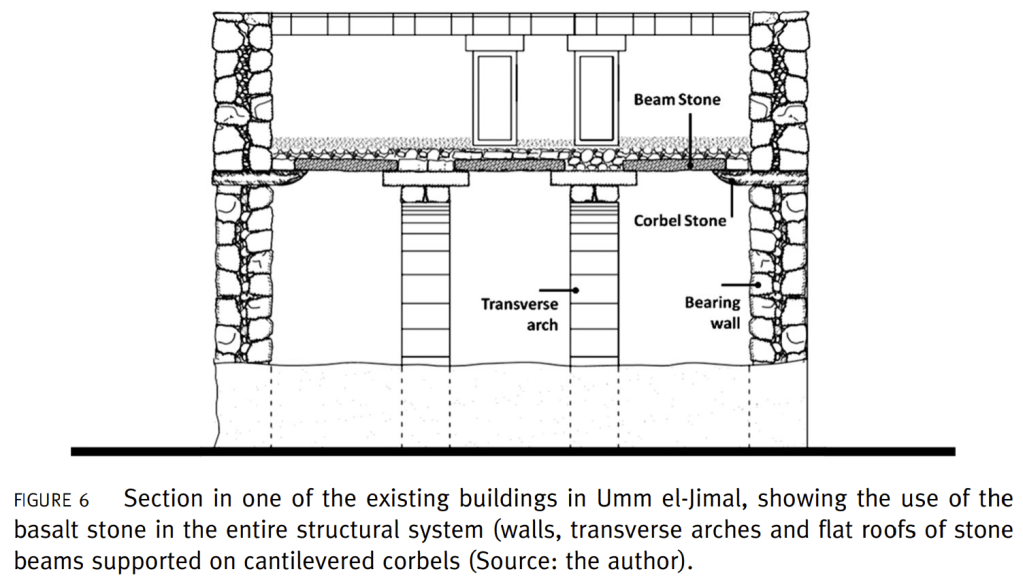
The basic idea of a corbel is a long piece of stone, at least a third embedded in the thick stone walls, and the remainder extending out over the room as a support on which to lay the cross-beams underpinning the floor or ceiling above.
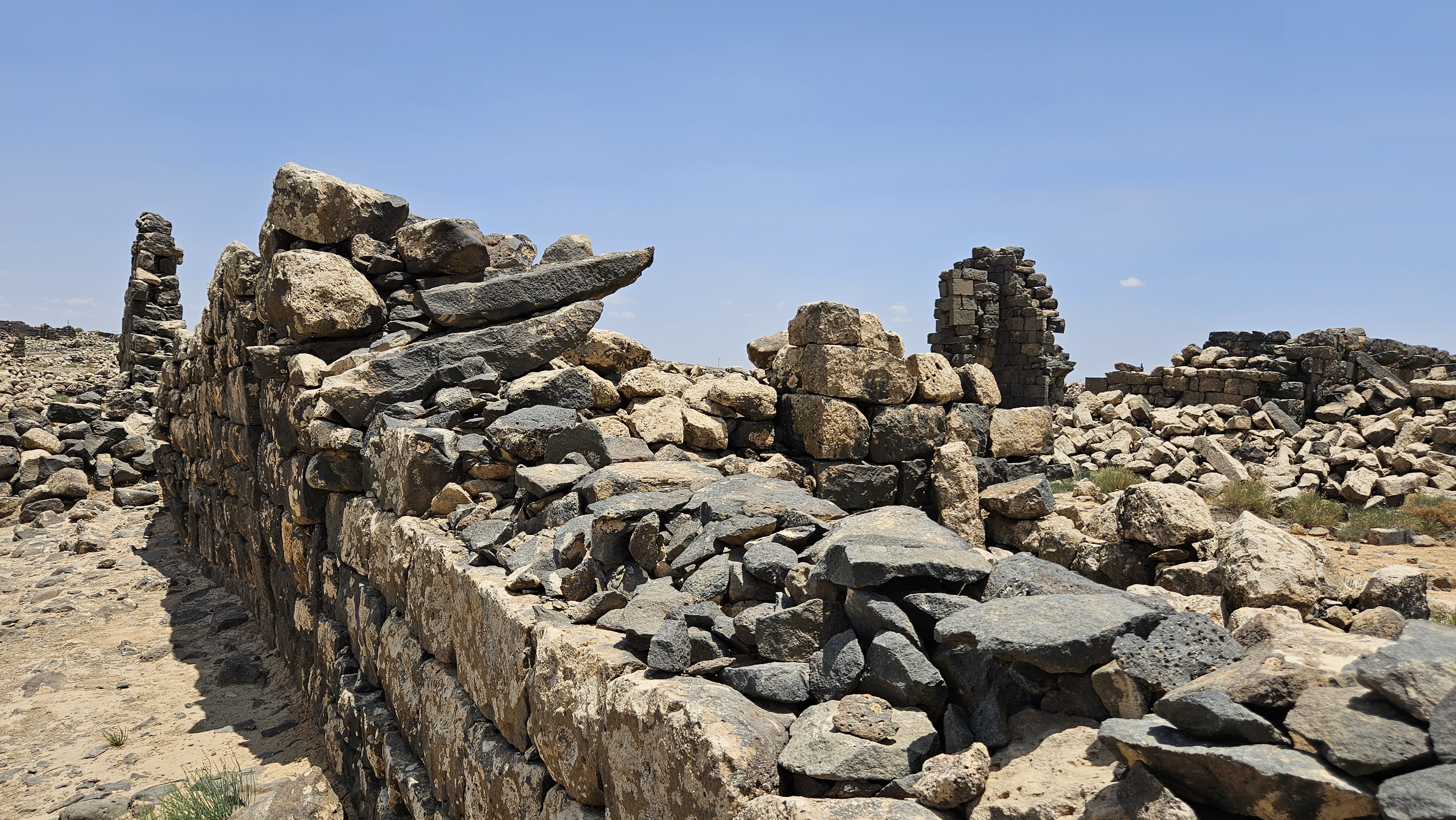
On the left you can see a pair of stacked corbels embedded deeply into the wall and extending out into the space. 
For many of these homes, the roof has collapsed but the corbelling remains, extending over lost rooms. 
Closeup of a home’s corbelling. 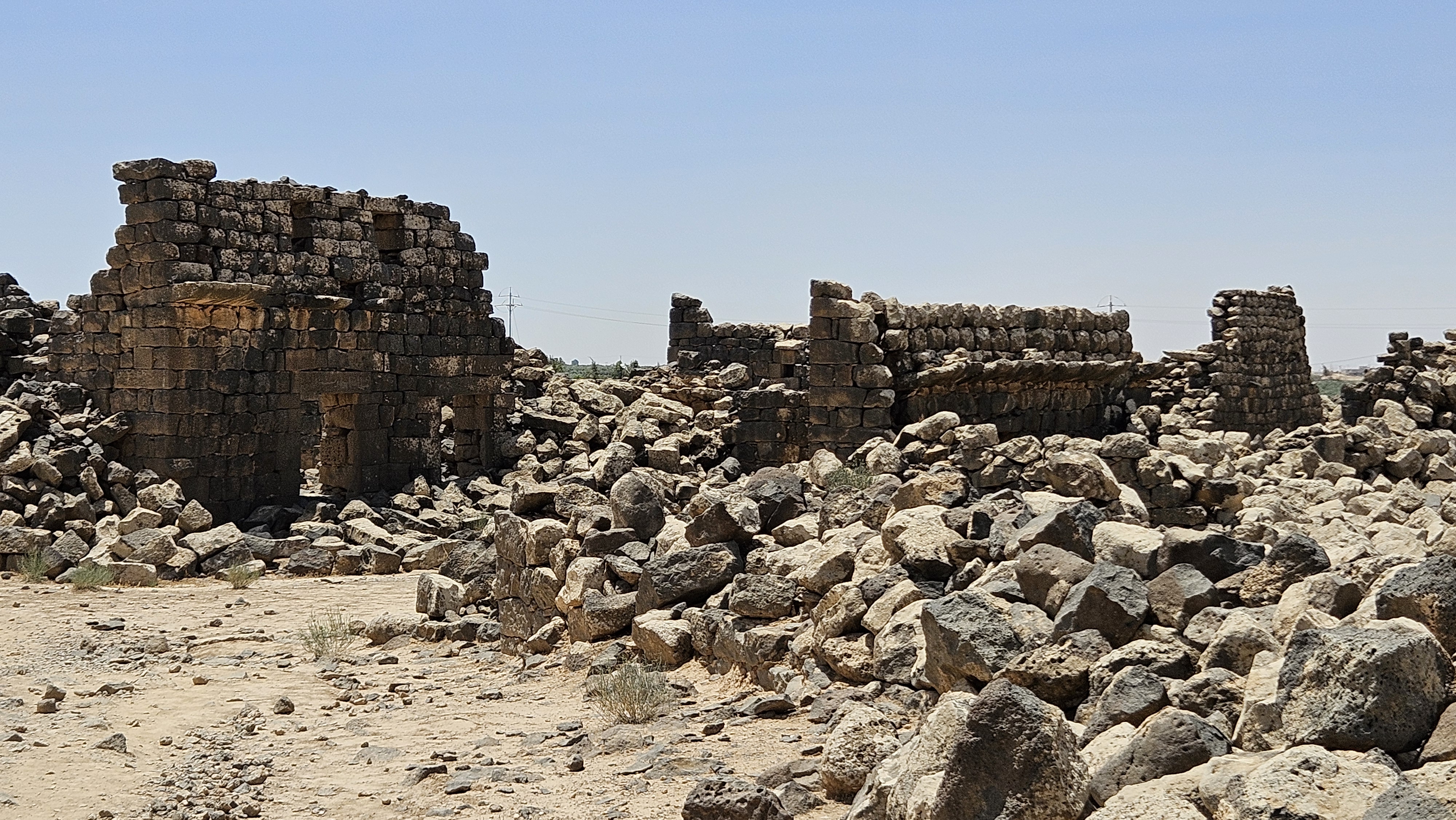
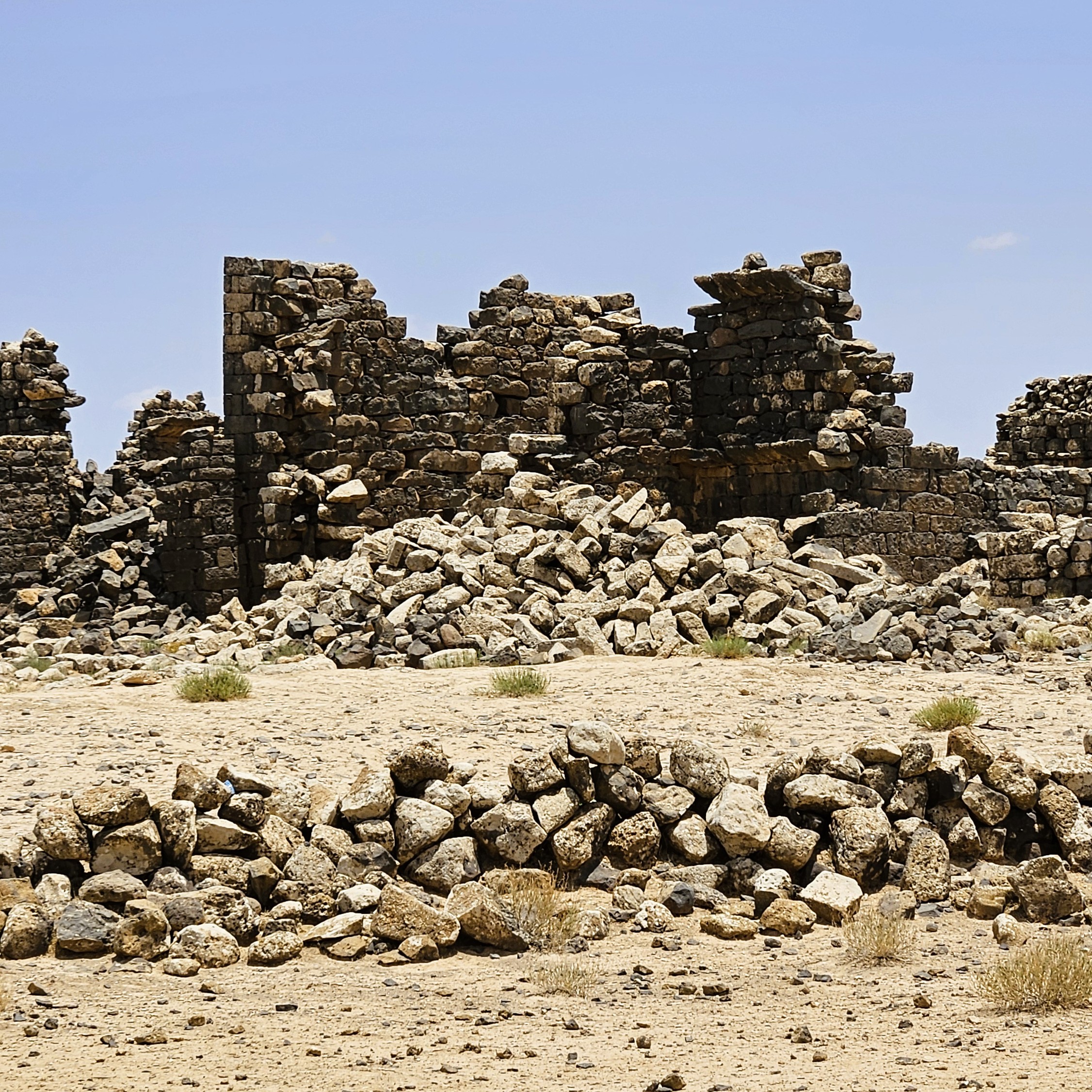
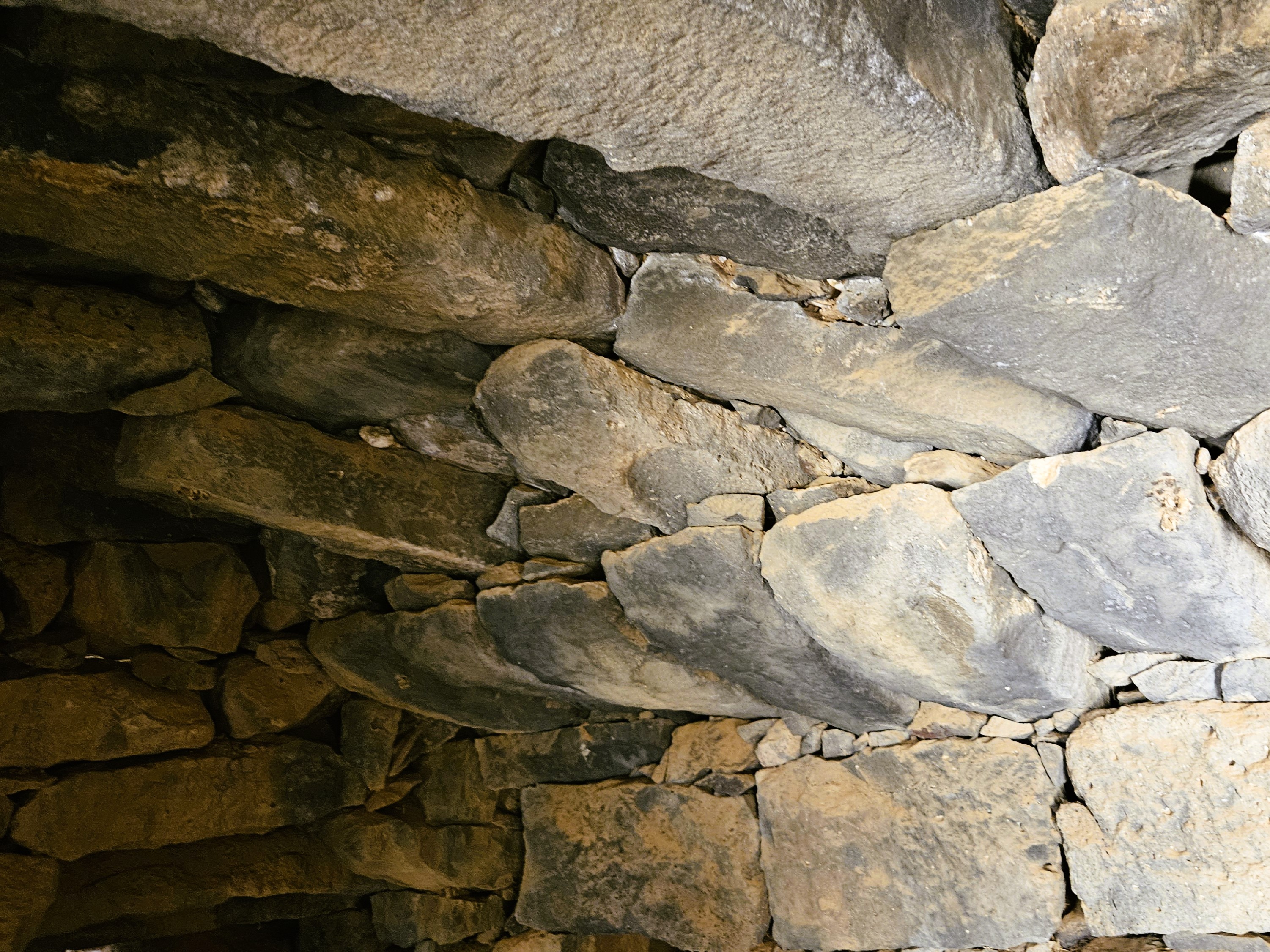
Double corbelling supporting the basalt cross-beams in the ceiling of one of the rooms of House XVII. 
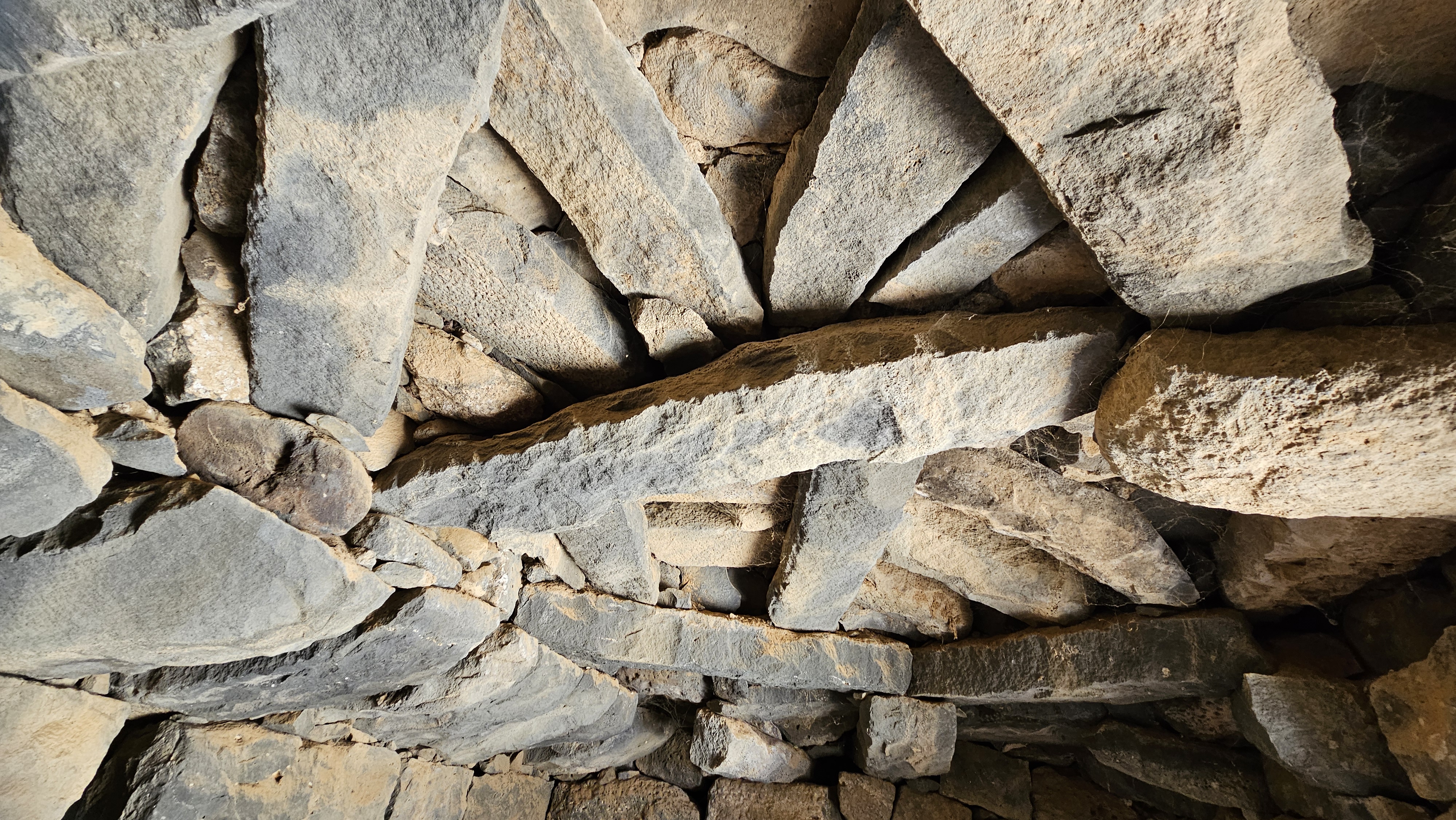
Rama Al Rabady calls this a “web-shaped” corbel style.
Cantilevered Stairs
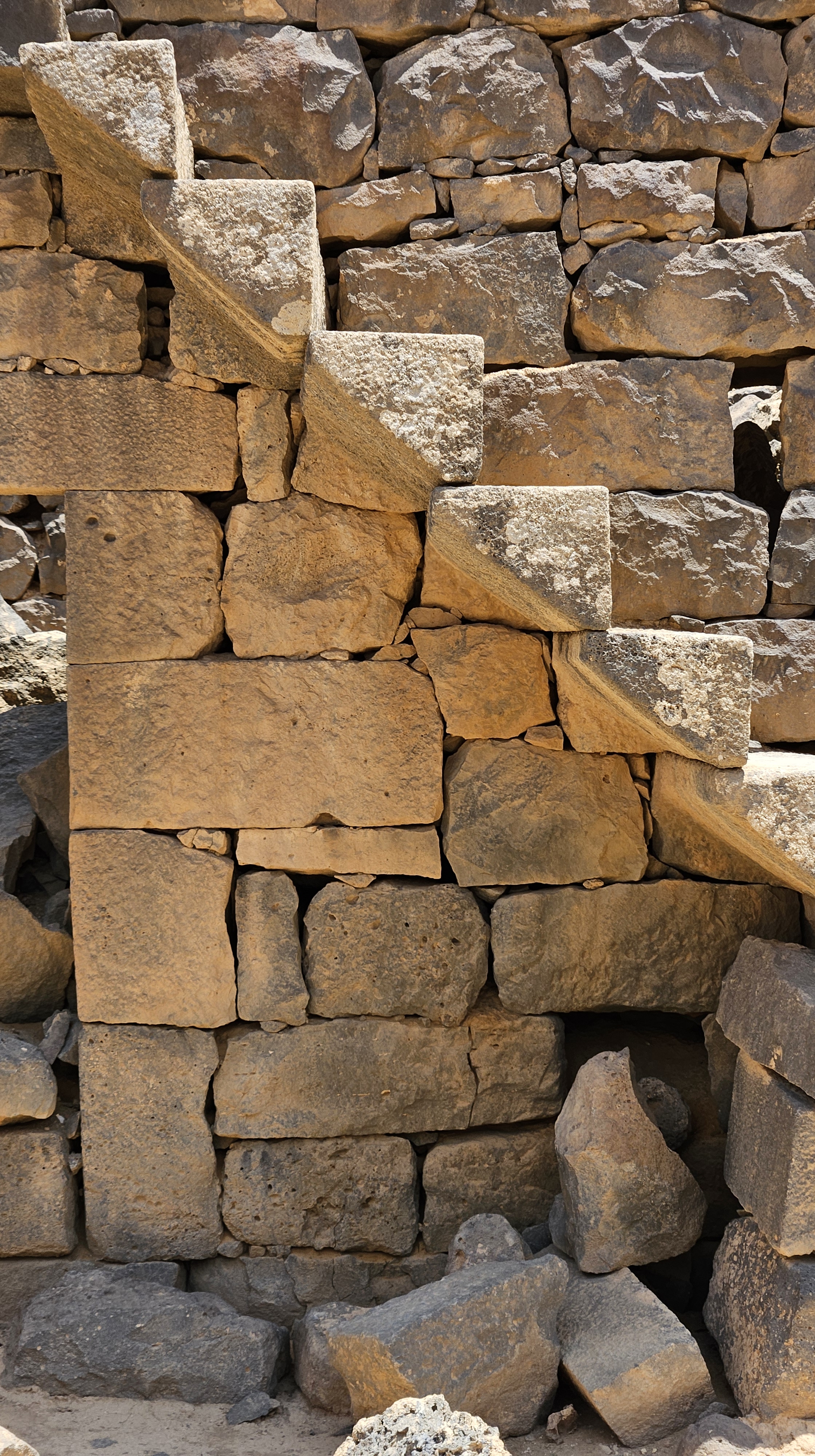
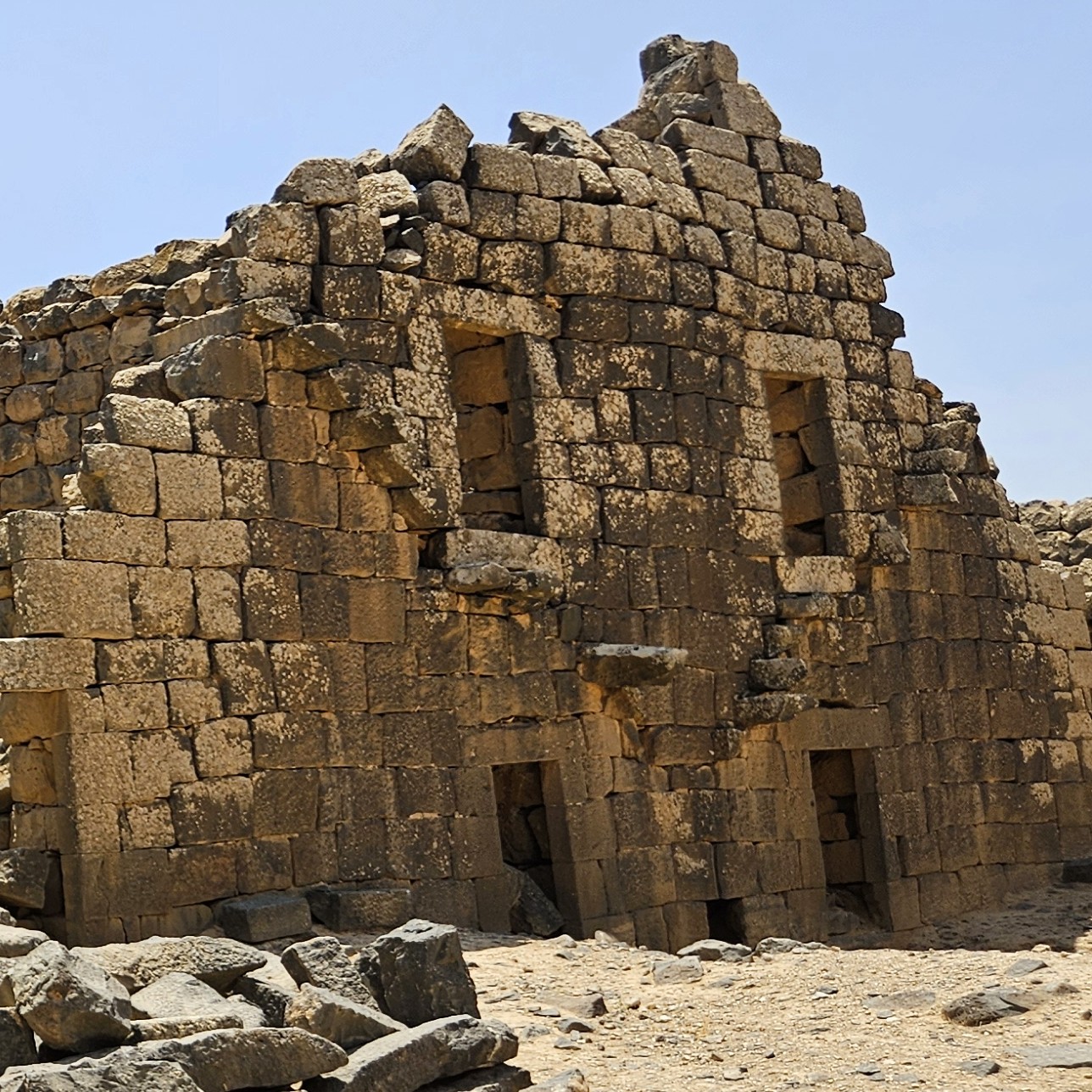
Along with Roman arches and similar to corbelling, cantilevered staircases are also very common in this construction, as we also saw at Azraq Castle. In this case, each tread of the stair is a long, narrow slab of basalt, half of it deep inside the wall like a corbel, and extending out into the air for the kind of staircase that gives me nightmares.

Lintel Relieving
Basalt is formed from lava flows. It’s one of the strongest types of stone, mot resistant to weathering, which is in part why the structures at Umm Al Jimaal, Umm Qais, Azraq Castle and elsewhere across Jordan have withstood the test of time so well. Basalt is also, often on a microscopic level, incredibly porous. A drop of water deposited on the top, our guide told us, will sink into the stone and emerge, years later, from underneath. This porosity makes basalt a key to the prodigious aquifers underlying the Harrat al-Shaam. It also means that, despite basalt’s strength, the porosity means that it can suddenly, after many decades or centuries, snap under stress.
This can make the lintels of doors and windows vulnerable, and the buildings at Umm Al Jimaal counter this by adding low arches or small windows above the lintel. This directs the weight of the wall above away from the center of the lintel and into the door jambs and walls on either side.

The gap above the doorway relieves pressure on the lintel. 
The walls fell down, or were pillaged for building materials elsewhere, but the doorway and arch relief remain. 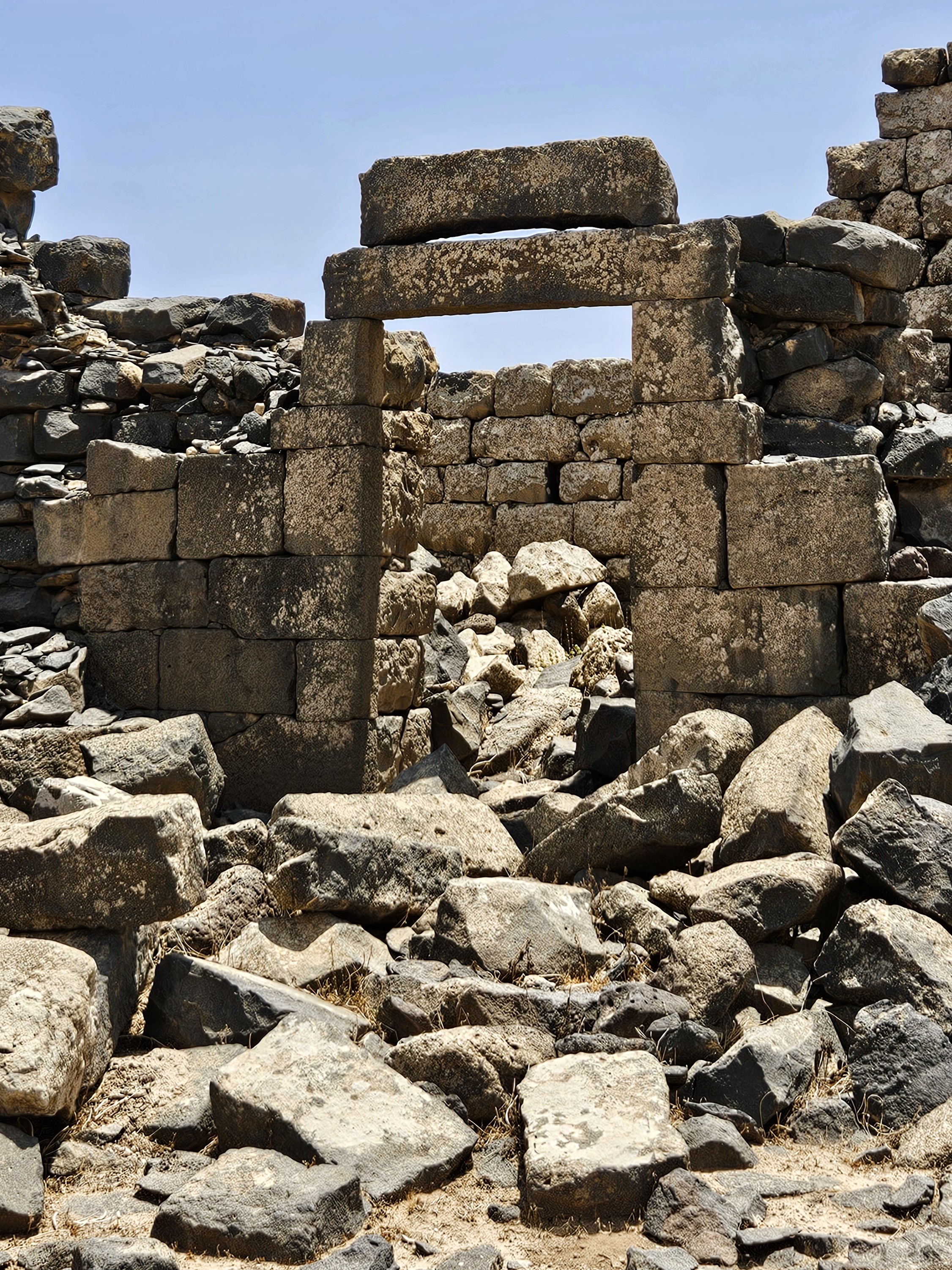
close-up of the door 
An inverted U-shaped arch relief redirects the force around this window, and note the cantilevered stair to the right. 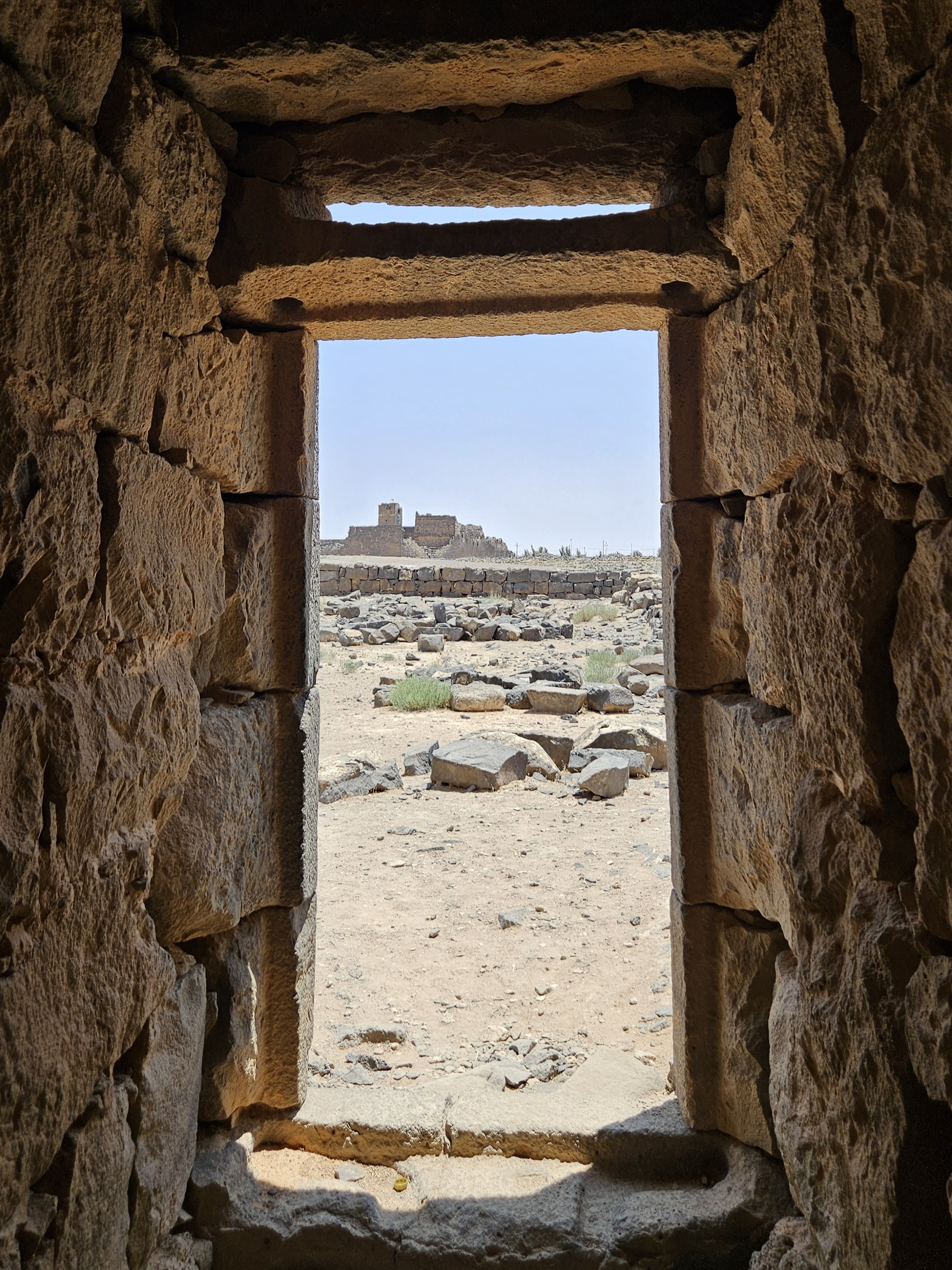
A door of the Praetorium with an inverted-U arch relief from the inside looking out…. 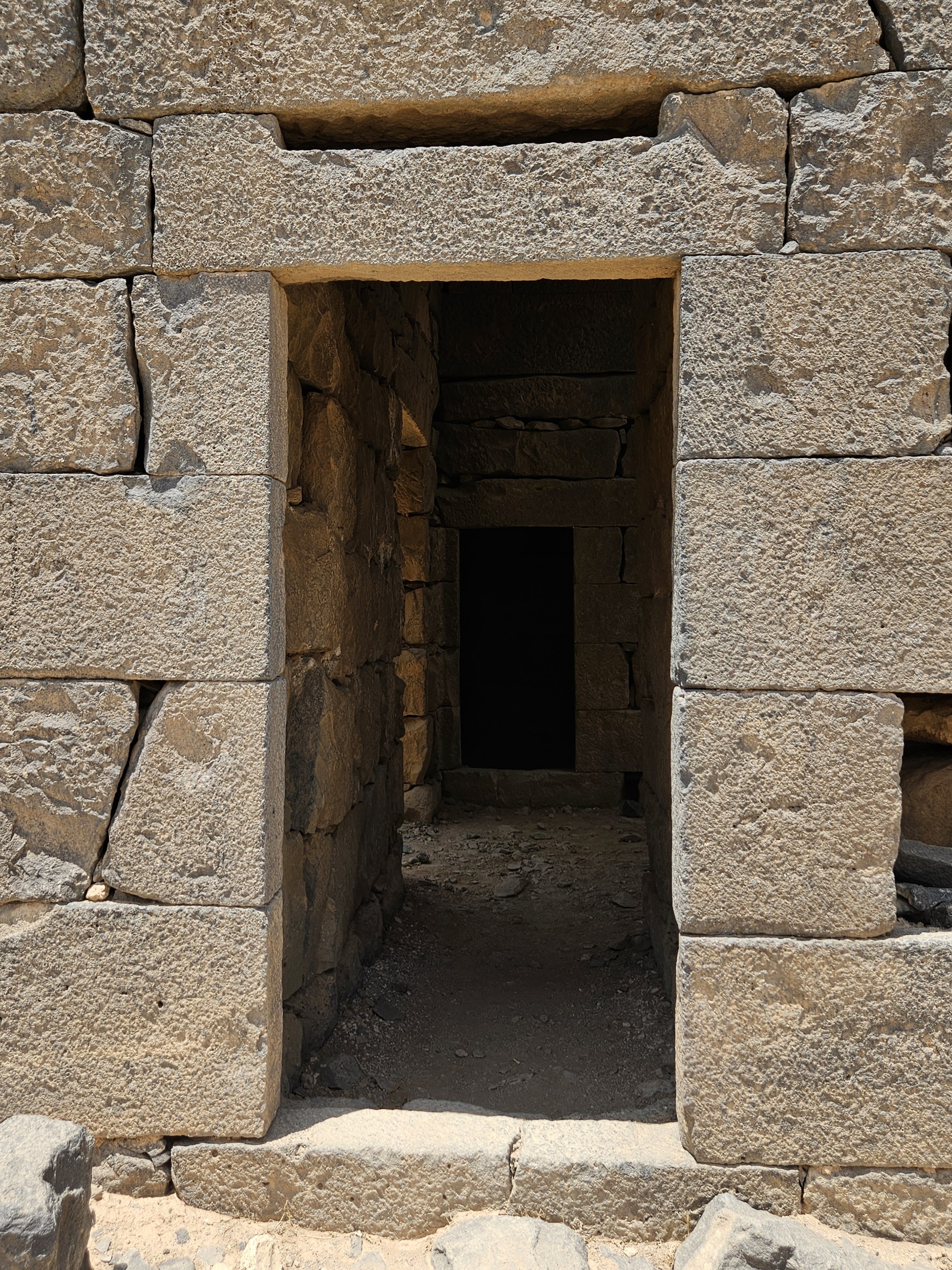
… and from the outside looking inward.
There are examples of all these architectural techniques scattered all over the half-collapsed homes in the residential neighborhoods, but are perhaps most elegant in the most complete home remaining.

A House of Means
Perhaps the best preserved residence in Umm Al Jimaal is known as House XVII and House XVIII. It probably belonged to a family of some financial means in Byzantine Umm Al Jimaal, and is actually more of a family compound, with several houses facing a shared central courtyard. It may have been used later in the Islamic period as a caravansarai, an inn for passing merchants.
The wealth of this family is evident not only in the windows indicating four stories in the building as it once was, but also in the detailing. The corbelling, for example, is finely carved as crowned molding. Inside the entryway, there’s still some of the plaster on the walls: a rough layer mixed with pebbles to even out the rough rock faces, and a finer layer of plaster only for finish.
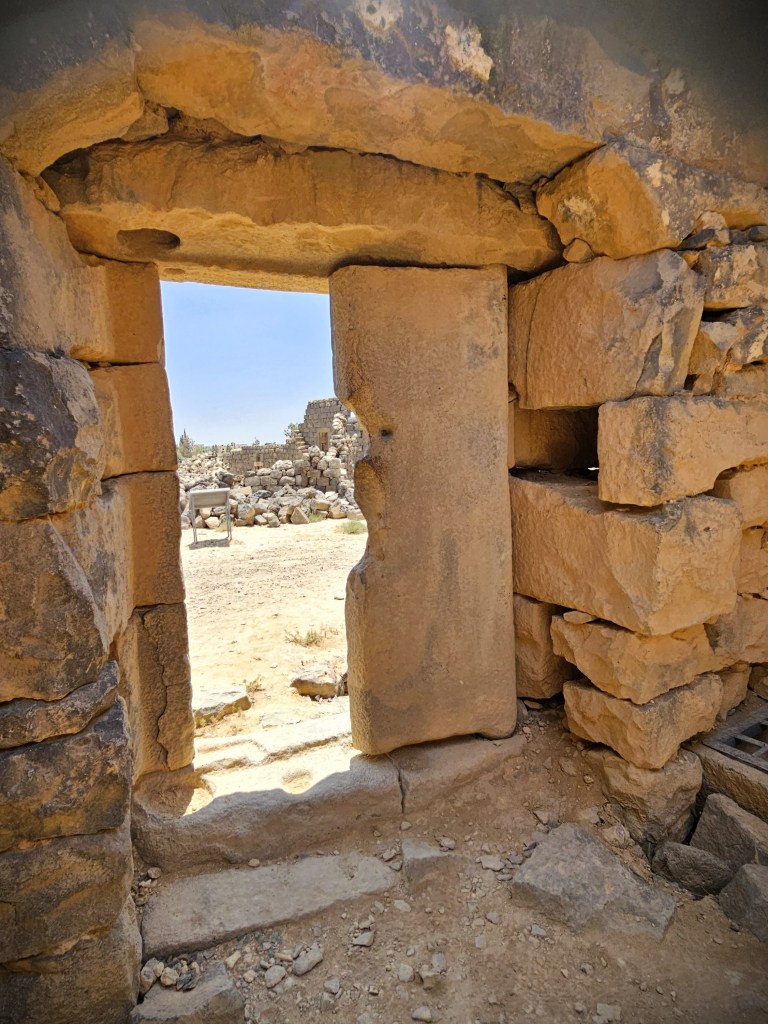
One of the basalt double doors is still standing, and even still operational! 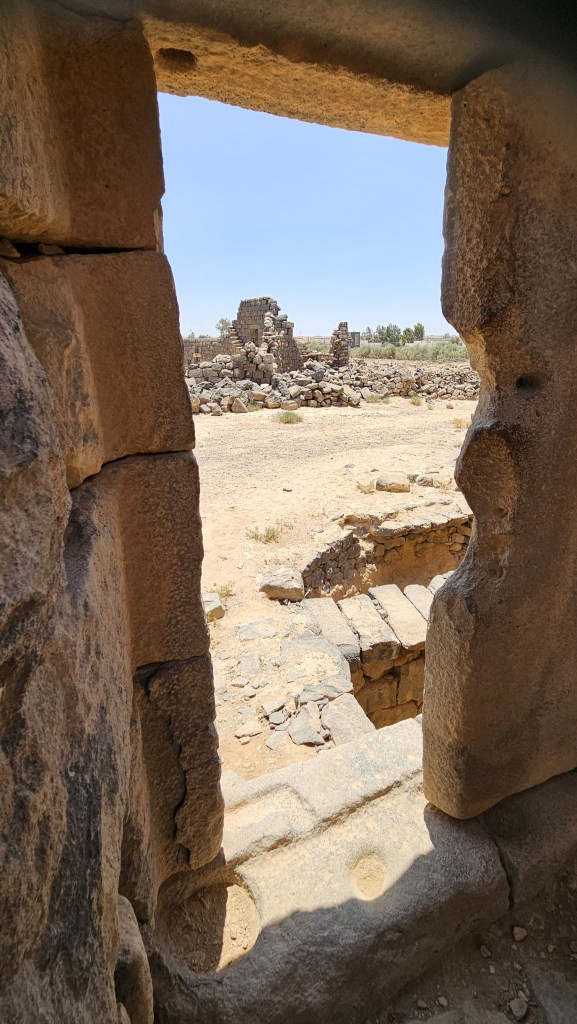
close-up of the door with the threshold carved to accommodate the door hinges 
This corbelling is both functional and decorative…. 
… with nice corner stones. 
Here you can see evidence of the rough pebble and plaster, and the finer plaster finish. 
The arches faced the street, and this hidden courtyard would be private. 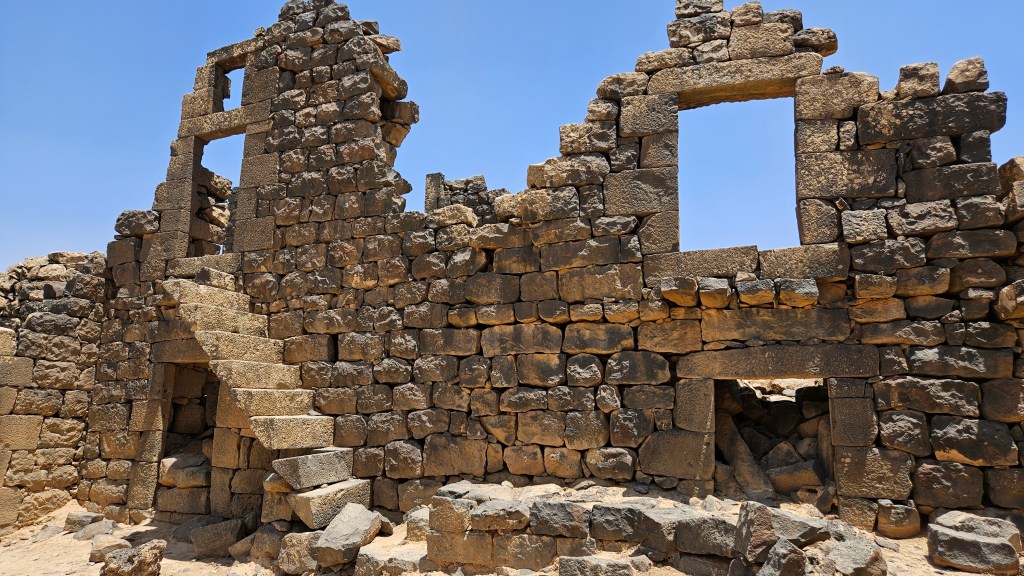
More corbelling, cantilever stairs, and a window above a doorway to relieve the lintel … this courtyard facade has it all!
These buildings were likely built by a family, with the parents on one side of the courtyard, and their sons in houses on adjacent sides. The courtyard may have been a shared space for children to play, for women to sit and do textile work together, possibly also cooking, and for smoking and socializing late into the night, just as Bedouin families do still on their patios today.
Rethinking Mary and Joseph
These central courtyards were also used for keeping livestock safe from desert predators at night while their shepherds slept. A secondary courtyard of House XVII and XVIII has several mangers built into the wall under a corbelled overhang, with bored holes for tying up the lead sheep or goats, which would keep the rest of the herd contentedly close.
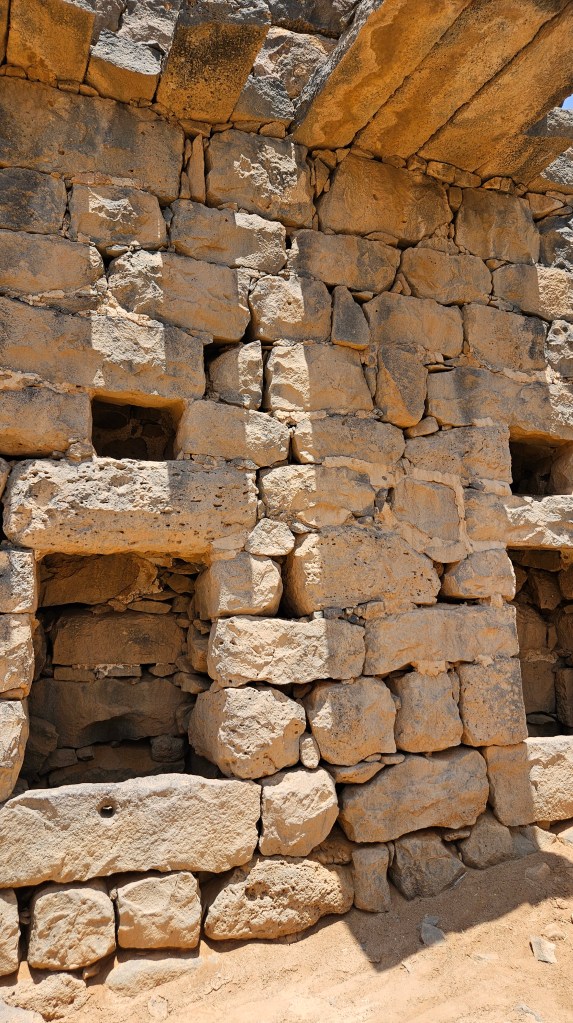


This arrangement, our archaeologist guide told us, and his observation of local culture in all his years of working in Jordan, made him rethink the Biblical story of Mary and Joseph in Bethlehem.
In the Bible story, the newlyweds Mary and Joseph and everyone else in Roman Palaestina are called to their ancestral home town to be counted in the census of the Roman Empire. Though they didn’t live in Bethlehem, it was their clan home, and Mary and Joseph would have had cousins and relatives there who would have a familial obligation to show them hospitality during their stay. It would have been ‘aib, a deep shame to let their relations, however distant, stay at an inn.
But remember, Mary is nine months pregnant at this point. If the homes in Bethlehem were like the homes in Umm Al Jimaal, and the family compound around a central courtyard goes back centuries in the Mediterranean, we have a problem. How is Mary supposed to get up and down those precarious cantilevered stairs while gravidly pregnant?
It makes much more sense to bring bedding for Mary down to the courtyard — the kind of floor mattresses rural people use in Jordan to this day are easily and constantly rearranged. And when the babe was born, the trough of that stone manger would make a safe place to keep a baby snug and safe.
Now that it’s in my head, I like this version better.
Water Systems
House XVII and House XVIII’s compound also includes that hallmark of a Nabatean-founded city: an extensive water provision system.
Umm Al Jimaal is situated at the confluence of three wadis, what we would call arroyos in Arizona. Water doesn’t run in them all year round, but is plentiful in the winter rainy season, more than enough to live from throughout the year. The Nabateans who probably established the first settlement here were geniuses at water collection and retention, and used that genius at Umm Al Jimaal. Of course, with the collapse of so many buildings, the system doesn’t function as it once did, but evidence of how it worked is abundant.
Water collection began where the three wadis approached the town, and the bounty of the rainy season was diverted into small covered canals that ran throughout the streets of Umm Al Jimaal. Every official building and most large houses had their own private cisterns beneath or beside them, as well as a number of public cisterns for shared use. Some were open to the air and used for livestock, others were covered and lined with plaster, providing potable water for families. And each cistern had both an inlet to fill it from the system of canals, and an outlet to let the overflow continue on into the next cistern in the system.
Estimates are that Umm Al Jimaal’s water system was even able to capture enough of the rainwater in a good year that the cisterns would have enough excess to support the community through a couple years of drought.
Here’s an example of a private cistern for House XVII:

This cistern is right outside the front door of House XV. 
Here you can see the canal running through the street out front that feeds into the House XV cistern. 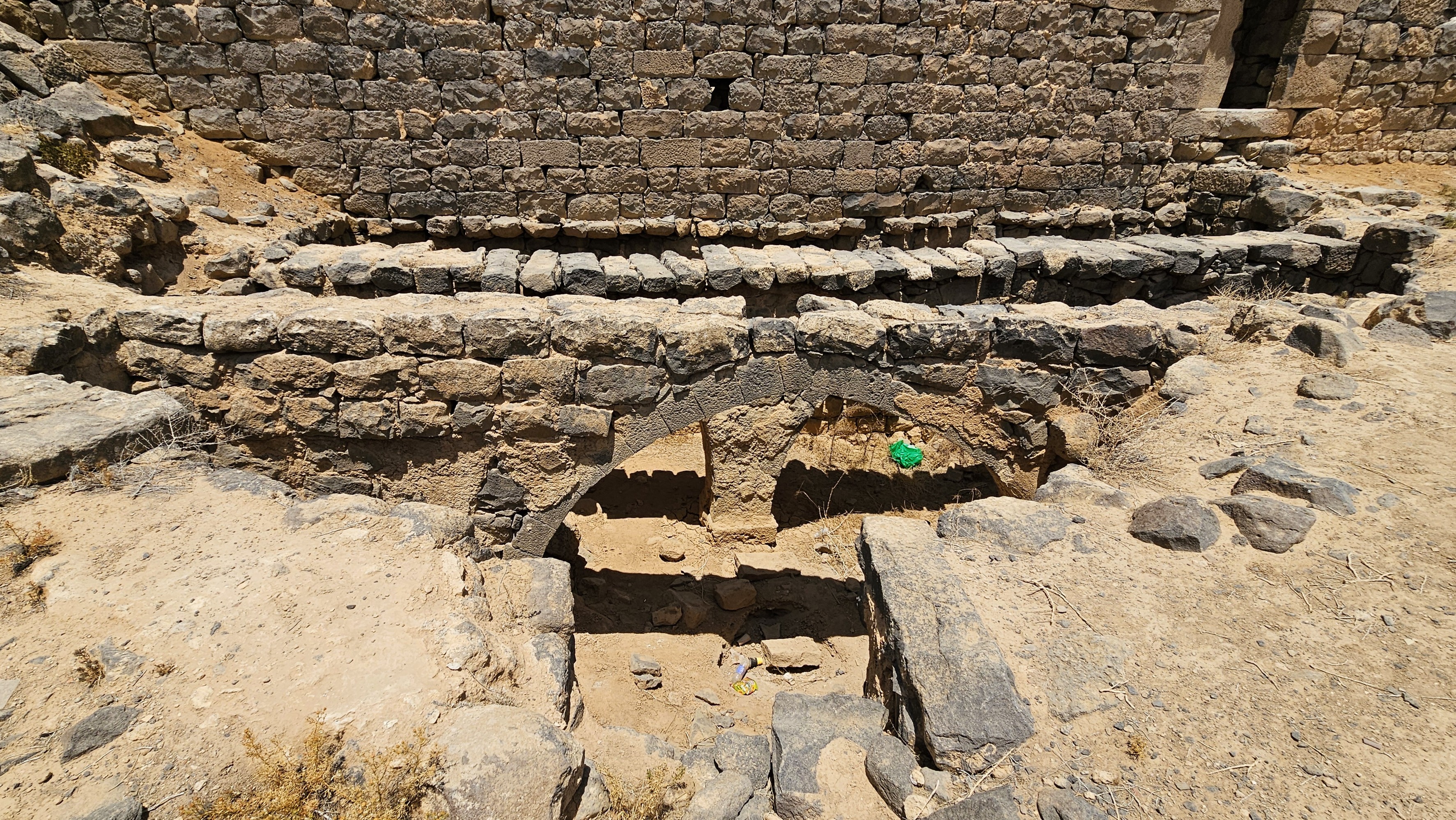
Arches and corbelling show that this cistern was once fully covered over. 
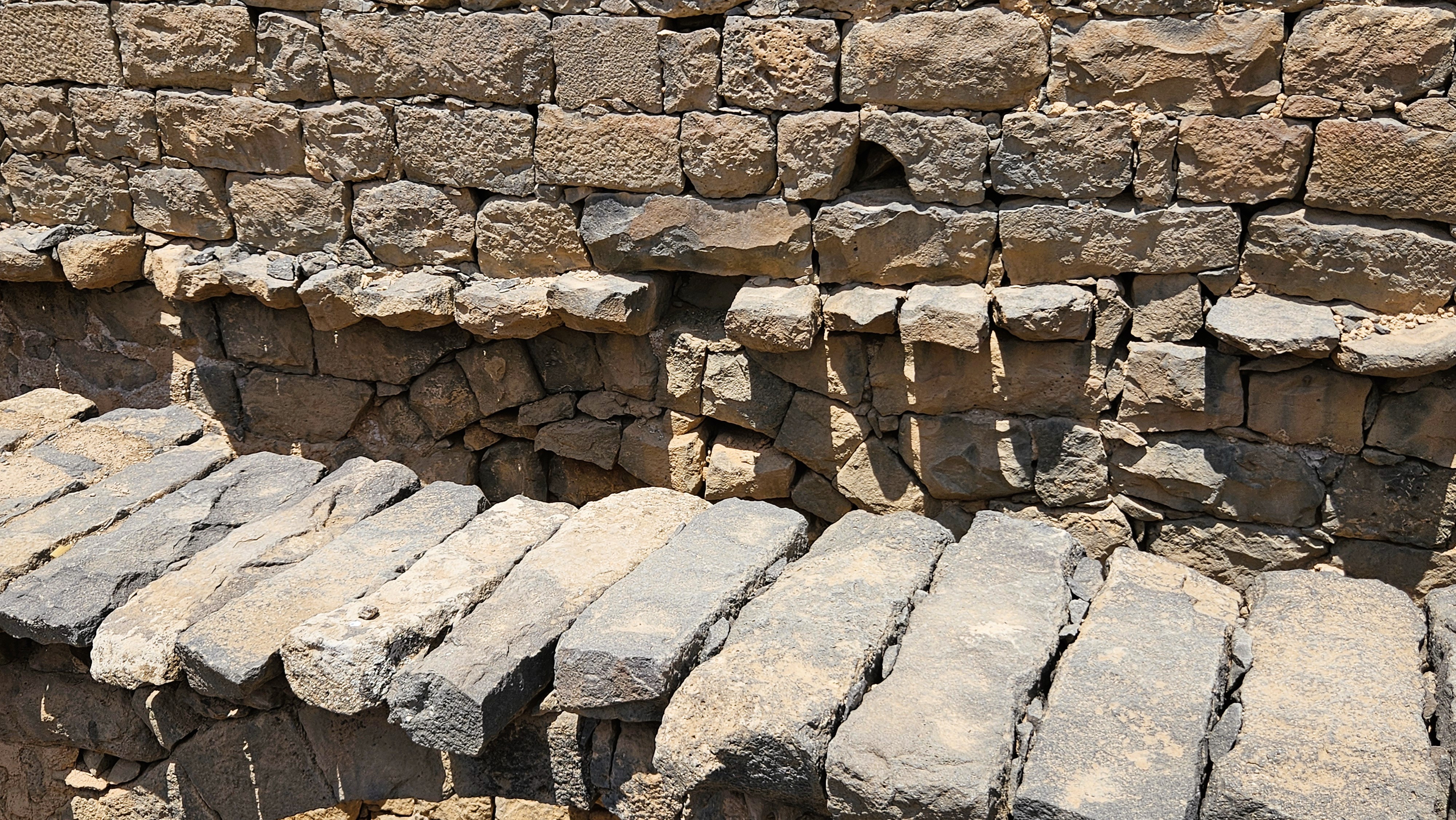
This arch in the wall behind the corbelling suggests that the cistern may once have extended inside the house. 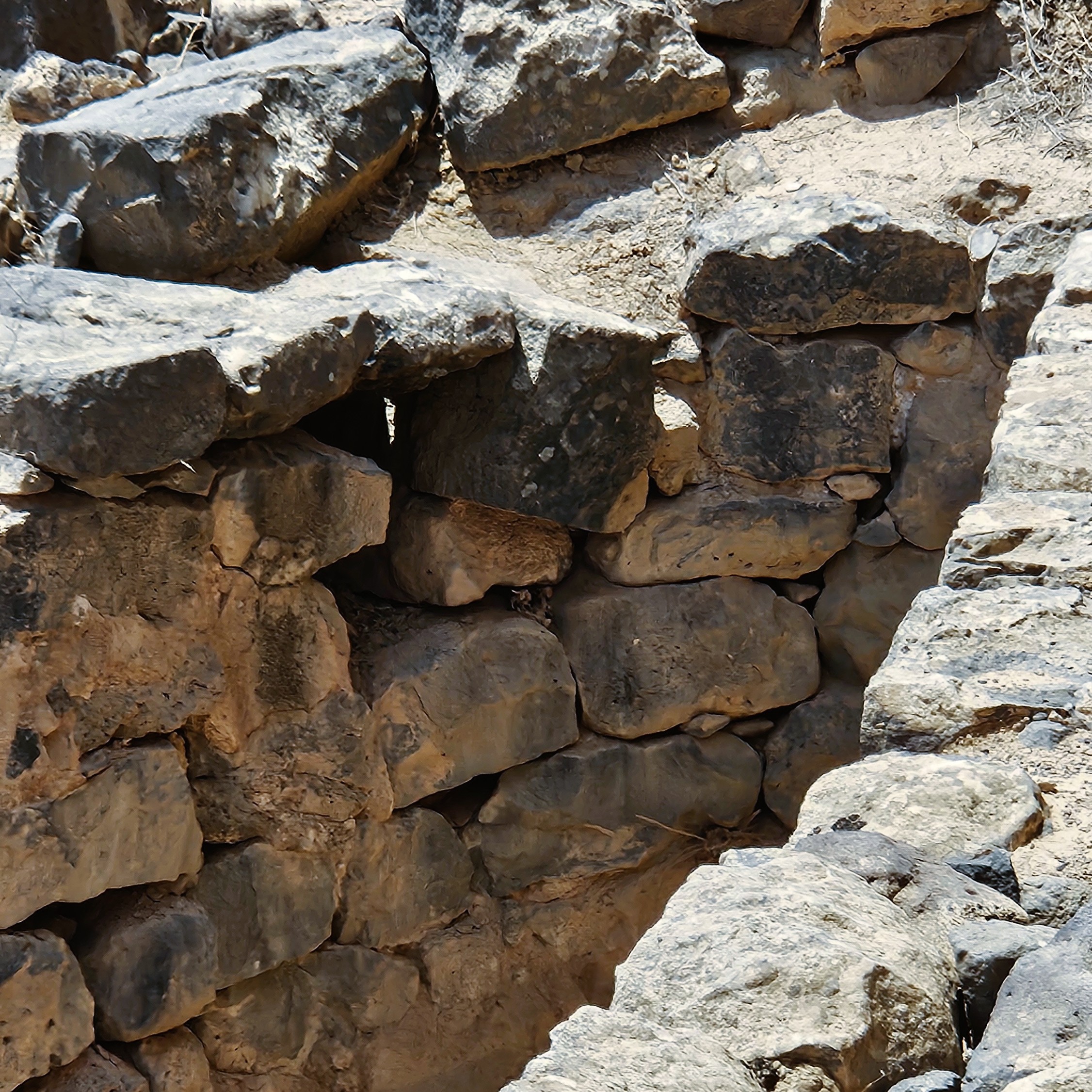
Here you can see the outlet that would have carried any overflow on to the next cistern in the system.
So Much to Explore
Honestly, we could’ve spent twice as long listening to our archaeologist guide explicate all the intricacies of this site. There’s so much to see, so much more than one blog post can capture.
If I haven’t bored you yet with excessive detail, there will be more to come on public buildings in Umm Al Jimaal, as well as its twentieth century history, in my next post.
 MaryahConverse.com
Leave a reply to Religious and Official Umm Al Jimaal – MaryahConverse.com Cancel reply