
Sixteen years ago, Nick George accidentally became a kind of patriot I admire when he was arrested for attempting to fly across the country with Arabic flashcards in his pocket. It is not because of the $25,000 settlement he won against the Philadelphia Police Department. It is because he was in the position to go to court at all, because the ACLU still had to pursue a case like this, more than a decade after the 2001 Patriot Act opened this door.

Since I began learning Arabic in the early 2000s, whenever I took a flight, which was often in the middle of that decade and a half of my life where I moved continents every year or two, I made it a point to carry my Arabic homework, a Harlequin novel translated into Arabic, or some other material in that curling script. I like to get to my gate early, and I was always very deliberate about taking out my Arabic material and working as I waited. It was a small civil disobedience, a dare to TSA and the airlines to come for me, because I was prepared to take my case as far as Nick had taken his.
But if you’ve seen me, you’ll know what’s coming next: Nothing.
I’m a well-dressed, slightly nerdy white woman. No one cares about the Arabic in my hands.
In fact, only one person has ever mentioned it, as I sat with Arabic textbooks spread out around me in the airport lounge sometime around 2007. “Are you studying Arabic?” I looked up to find a uniformed stewardess, perhaps twenty-four, with long waves of blond hair. “That’s so cool! Is it hard? I’ve heard that it’s really hard to learn. Don’t you have to learn a whole new alphabet and stuff?” She gushed for more than ten minutes about how smart I must be, clearly not concerned that I might be a terrorist.
It was embarrassing, but I wasn’t one of the dozens of Black and brown people who were dragged off of planes in the early 2000s for talking to his uncle on the phone, texting a friend, being named Mohammad, moving to an aisle seat or worrying about their child’s safety while wearing hijab, sweating, or asking for water. It wasn’t even comparable to my dozens of Muslim and Arab friends who’ve been “randomly selected” for extra TSA screening every time they fly.
* * *

There is a very short piece by the Palestinian-American poet Naomi Shihab Nye called “Gate A-4” about an announcement she heard over the PA system at the Albuquerque Airport asking for someone who speaks Arabic. She arrives at the gate to find an absolutely distraught Palestinian grandmother whom Naomi, with a few words of Arabic, is able to comfort, a small gesture that ripples across the passengers of Gate A-4 in beautiful ways.
“I thought, This is the world I want to live in. The shared world. Not a single person in that gate—once the crying of confusion stopped—seemed apprehensive about any other person.”
In airports, I always have an ear open for that announcement, “Is there anyone who speaks Arabic?” So far, it’s never come to that for me, but I’m always ready.
Once, in fact, on a long delay leaving Frankfurt for Amman, I did find myself reading my translated Harlequin romance across from an older couple who were arguing over what the last announcement at the gate had been, and I was able to explain to them that we were being delayed again, but that our flight would go on that day. It wasn’t the full Shihab Nye experience, but it felt good.
* * *
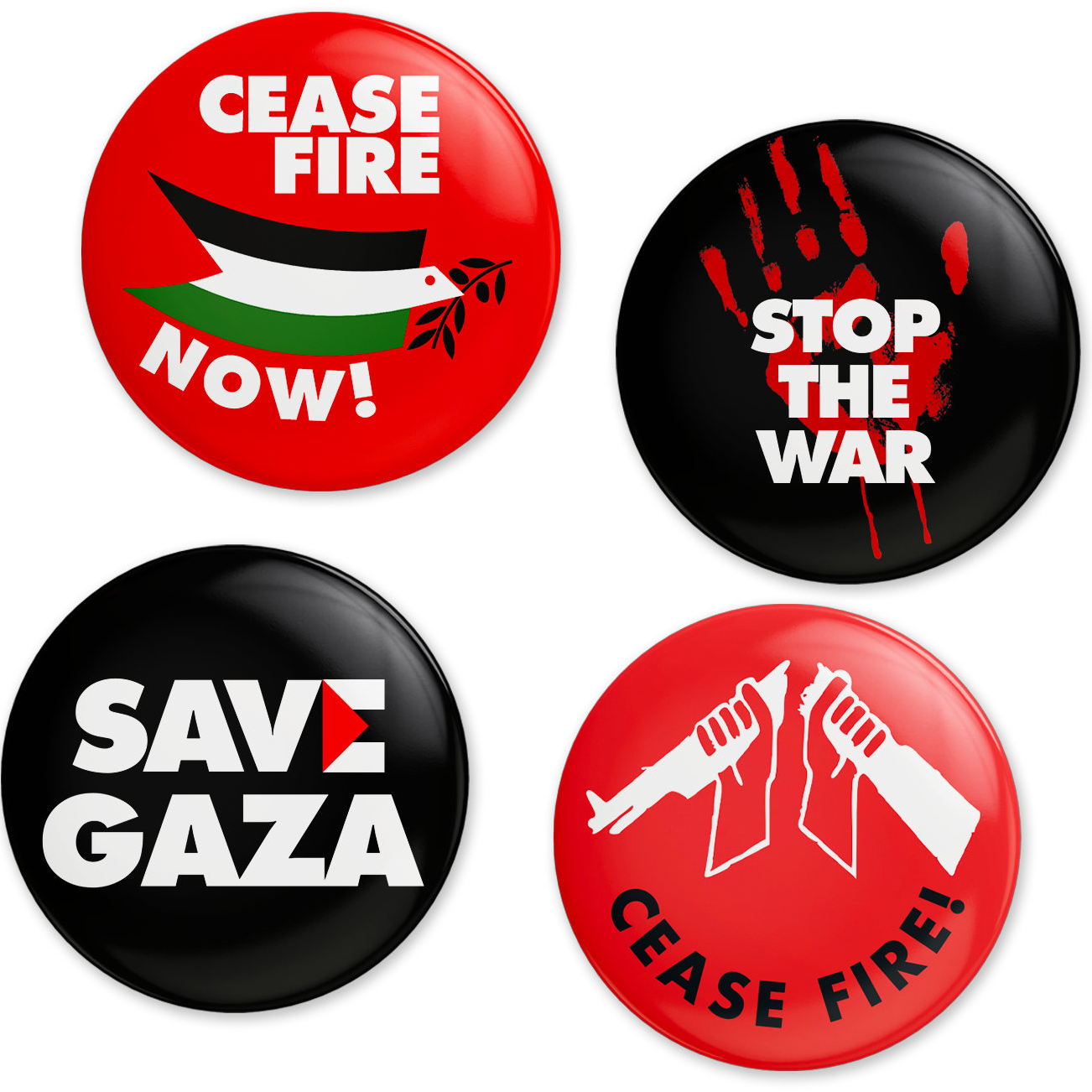
I have had on my bag for almost fifteen months now a very small button (I wish I’d found one larger) that says “CEASE FIRE NOW” with a small Palestinian flag. No one has ever commented on it. I rarely remember that it’s even there.
For the second time this month, although it had never happened to me before, on my way through TSA security, my bag was flagged for further inspection. Last time, it was my bullet journal and dissertation research journal – I’ve read that books can look like explosives in their scanners. This time, a small, blond, mild-mannered TSA agent asked me, “You’re traveling with a cat?”
“I am.” I gestured for Mr. Fellow to go on with the other TSA agents who were taking our cat and his carrying case into a private room for screening.
“This is litter?” he asked, gesturing to the small bag hanging from my bag by a carabiner. He had to take a tiny little bit of it and apply a liquid to it that would determine it was not dangerous. He also had to open up our cat food bag to ensure that it was what I said; it seems that the scent alone was enough to convince him.
As I was packing my things back up again while he watched, he pointed to the tiny ceasefire button on my backpack. “I like your button.” I was surprised; it was probably written all across my face. He went on to explain that his wife had painted something like it on their car, and had nearly been run off the road because of it. That really surprised me; as red as Arizona is, I’ve never been challenged for my ceasefire pin or Palestinian keffiyeh. “I don’t understand why people are so upset about it,” he said.
“I know!” I exclaimed. “All we want is for children to stop dying!” I often start with this angle on the slaughter in Gaza, because who would approve of children and newborn infants being killed by the thousands?
As I walked away with Mr. Fellow and the cat, I found myself ruminating on my assumptions. All those stories about Black and brown and Muslim and Arab folk being targeted in airports has made me see the security apparatus there in an adversarial light, and I do believe there are many reasons to be skeptical of the carceral surveillance state. Still, I’m occasionally reminded that within those systems are people I can find common ground with, and that’s no small thing in our new reality.
* * *
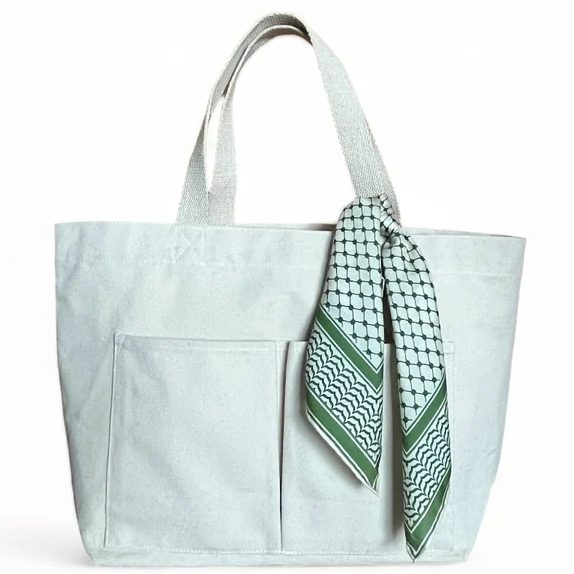
Sarah Musa is a New York modest haute couture designer, a proud Korean Palestinian Muslim American, and the twin sister of a friend of mine from an earlier life in Amman, Jordan. When the current campaign of violence began in the Gaza Strip, Sarah Musa accelerated a project of personal significance that she’d had on the back burner for some time, finding a small family operation in Turkey to produce her uptown silk blend version of the traditional Palestinian kefiyyeh or HaTTa head covering. I went for the bandanna size in the green variation to “reflect the color of the olive leaves and the olives,” and it has been tied to my schoolbag for more than a year. No one has ever commented on it, and I’ve never known if anyone recognizes it for what it is.

As we boarded our Houston to Frankfurt leg of our journey, we found ourselves seated next to a black-haired, copper-skinned man who warned us that he was traveling with a dog who might get testy mid-flight; we let him know the same might (and indeed did) happen with our cat. It turned out he was also headed ultimately to Amman, where he had recently moved with his family so his kids would learn better Arabic. When he found out our plans, and that I spoke Arabic, he mentioned that he had noticed the green silk kefiyyeh on my bag and that he had wondered what it signified, especially when he’d then seen Mr. Fellow throw down his red and white kefiyyeh (which he finds multiple practical uses for on a long flight) as we settled in for the flight.
Some will deride it as virtue signaling: the button, the bandanna, the kefiyyeh, an Arabic novel in the airport. Most days it feels like the literal least of all the things that I could do to build positive change in the world. But people see these symbols, these signals; they notice. On the best days, it opens conversations. It’s not nothing.
 MaryahConverse.com
Leave a comment