As I’ve published about before, it’s always surreal for me to sit in the American sunshine and read about events happening in Gaza, the West Bank, Syria, Lebanon, Iraq, and other Arab communities to whom I feel some degree of affinity and empathy.

I haven’t had the bandwidth to do much creative writing since starting my PhD, but from time to time, a story or poem has pushed through the noise. Most of this work has been short – flash fiction and poetry – in response to the slaughter in Gaza and the reaction to it. Three of these short pieces have been chosen for publication or reprinting in the #Genocide Anthology.
“Mother. Land.”
I’ve learned a lot in the last year and a half about indigeneity. I’ve had an interest in Native American history since early elementary school, but in a casual way; I’ve never been serious about indigenous studies as a discipline. I understood that indigenous people’s were the original inhabitants of a land, with a commitment to maintaining the histories and traditions of their culture. I saw that in the Palestinian struggle. What I hadn’t understood about indigeneity is the depth of the connection to the land, not as a place, but as a lifeblood, not just a part of the family but an extension of the body.
The closest I’d come to this understanding prior to the current developments in Gaza was the Palestinian attachment to the olive tree. Notoriously slow to mature, an olive tree won’t bear fruit for at least 5 to 8 years, but even then the harvests will be spare. It could be 15 or as much as 35 years before the tree reaches its full fruiting capacity. Once it does, though, an olive tree offers a full harvest for centuries, and can live as long as a millennium. Palestinian olive farmers call their trees their children, and those trees nurture families for generation after generation.
Among other things, this piece of very short fiction, “Mother. Land.”, attempts to convey that depth of connection between the Palestinian people and the generations of their ancestors who tended and were supported by the land, and the wrenching disconnection of repeated forced removal from the land.

“Obituary of a Clan”
This started as what’s known as a “hermit crab” exercise, in which a writer attempts to use one kind of written text – an application, a governmental form, a police report – to tell a complete story of a different sort. In my work as a fundraiser, I read a lot of obituaries, and I’d always wanted to use that experience in my creative writing.
I wasn’t going to participate in FlashNaNo, the microfiction version of National Novel Writing Month (NaNoWriMo). This event always happens in November, under the logic that if you can develop a daily writing practice in the month of elections, semester midterms, Thanksgiving and Christmas shopping, you can have a writing practice any time. This was also the month last year that I was finalizing my comprehensive exams and writing my dissertation proposal, so I was going to focus on that writing instead.
Then I got that Day 1 prompt: Write a story in the form of an obituary. I picked up my pen and couldn’t stop writing. It started as prose, but I quickly realized it would only make sense, could only be followed with the conventions of poetry.
“Obituary of a Clan” takes on one of the more tragic realities of the current conflict in Gaza. In the past 18 months, over two thousand families have been fully erased from the face of the earth, every single person killed, and more than twice that many families have been reduced to a single person. Palestinian families are large and sprawling, and when they’re decimated like that, hundreds of little stories and personal details are lost. This poem imagines what some of those lost details might be.

“Interdependent Web of Resistance”
As I told my student when she found me scribbling madly away under a tree on campus, I don’t always write poetry, but when I do, there’s a conflict in the Arab world, whether the 2008-2009 Operation Cast Lead, aka “Hannukah War,” in Gaza, or terrorism rocking the Arab diaspora in Europe. And while I’m usually more comfortable in prose, sometimes my emotional state can only be described in verse.
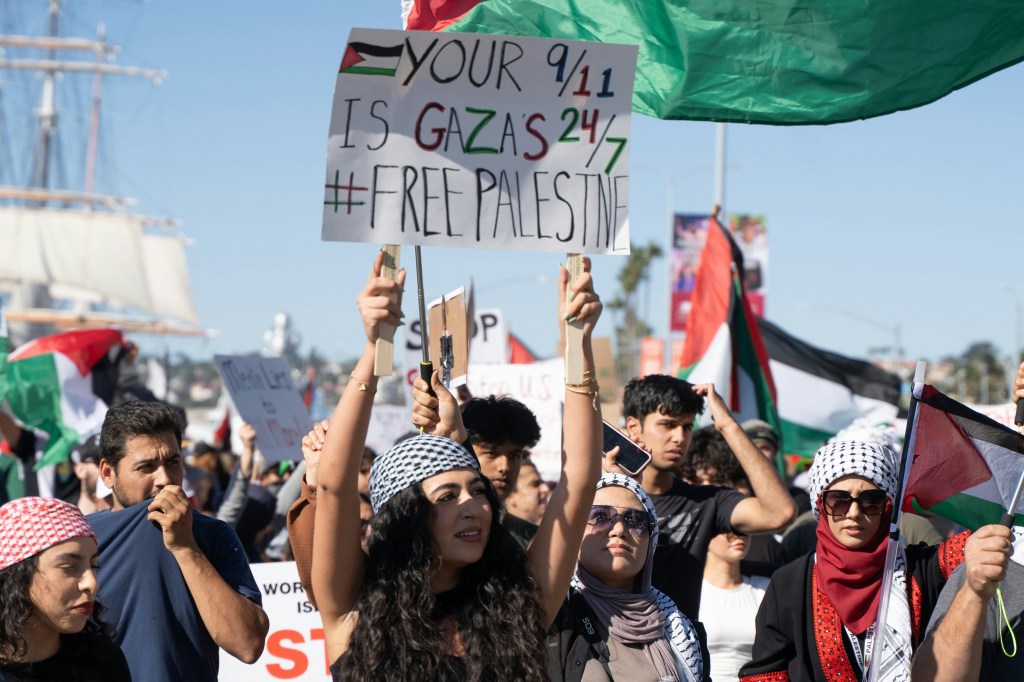
In the student protests of 2024, I kept seeing and hearing echoes of other protests and other times, including some that I’d taken part in; couldn’t stop thinking about the genealogies of protest movements, how they learn from each other, inspire each other, century after century. This poem emerged from a series of TV news and public radio stories, Facebook Reels and social media posts, that came together with what I remembered observing in other waves of protest, from the Egyptian Revolution to Occupy Wall Street to the Ukrainian Maidan to Ferguson Black Lives Matter and returning again and again to Gazans. Every new story I heard would trigger the memory of a dozen earlier explications.
An abbreviated version of this poem won the Shooter Literary Magazine 2024 Poetry Competition.
* * *
The anthology is available in paperback and as an e-book – use the discount code BCORPBOOKS15 for a 15% discount.
 MaryahConverse.com
Leave a comment